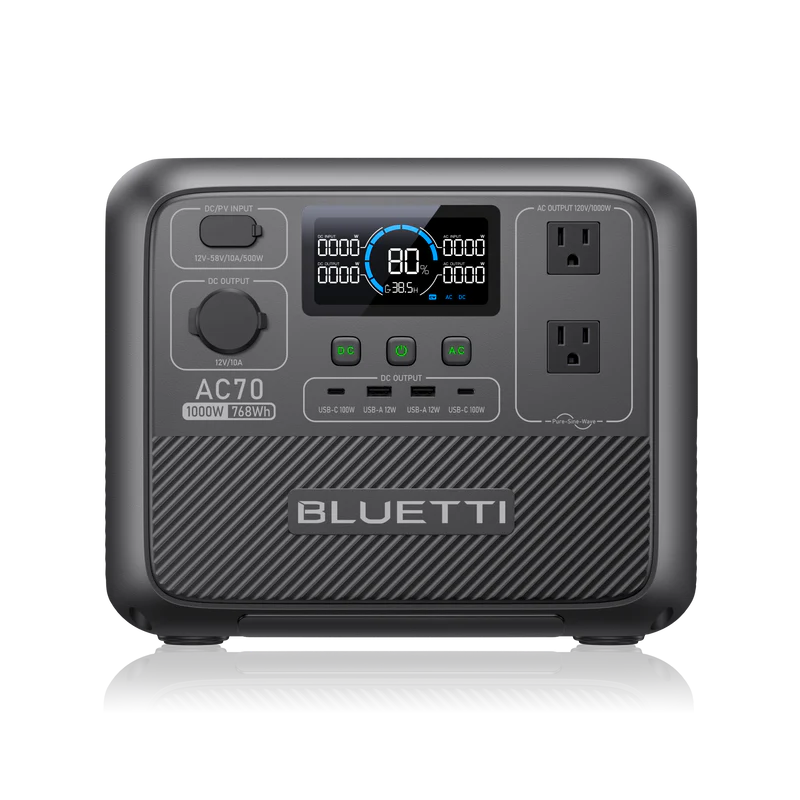
Our verdict
Useful portable power.
Check the buying options.
The AC70 is worth understanding if you already own one or find remaining stock with clear warranty coverage. It balances a modest energy reserve with enough output for many everyday loads, provided their combined running and startup demand is compatible.
For a new purchase, compare available alternatives before committing to accessories for a model the US store currently marks discontinued. An attractive station price means little if the batteries, cables, or support you need are difficult to obtain.
Review method: We assessed official specifications and documentation. We have not bench-tested this model. Runtime figures are calculated examples; charging times and cycle life are manufacturer claims.
Reasons to consider it
- Lower carrying weight than the AC180.
- Two USB-C connections for compatible devices.
- Fast wall charging when conditions allow.
- Solar and vehicle charging options.
- External Power Bank charging arrangements.
Tradeoffs to weigh
- Current US station listing marked discontinued.
- Only two household AC outlets.
- High loads use the energy reserve quickly.
- No directly integrated battery expansion.
- Bluetooth requires a nearby connection.
Key specifications
The numbers that matter.
| Battery | 768Wh · LiFePO₄ |
|---|---|
| AC output | 1,000W total · Two US 120V outlets |
| Power Lifting | Compatible resistive appliances rated up to 2,000W; actual operating power stays at 1,000W |
| Other outputs | Two 100W USB-C · Two USB-A · 12V/10A car outlet |
| Solar input | 500W maximum · 12–58V · 10A maximum |
| Weight / dimensions | 22.5 lb (10.2 kg) · 12.4 × 8.2 × 10.1 in |
| UPS transfer | ≤20ms specified |
| Connection | Bluetooth app control |
| Manufacturer claims | 3,000+ cycles to 80% capacity · Five-year warranty advertised |
References: US listing and AC70 manual. Verify regional specifications and warranty eligibility for the actual purchase.
Appliance compatibility
Start with the normal output limit.
Add the electrical demand of everything you plan to use at once. A fridge and laptop may fit comfortably while a cooking appliance consumes most of the allowance by itself. Outlet count does not multiply the station’s available power.
Check microwave electrical input, not cooking wattage. For a compressor or motor, confirm startup compatibility separately. The presence of a low running-wattage figure does not prove that an appliance will start.
Likewise, a UPS transfer-time specification does not guarantee that every router, computer, or storage device will remain on. Verify the actual equipment and operating mode before relying on the setup.
Charging
Fast charging, with a specification caveat.
BLUETTI’s documentation differs on maximum AC charging power: the current manual and listing highlights say 850W, while the same listing’s comparison chart and marketing section say 950W. Check the exact unit’s label and current manual; we do not present 950W as a universal verified limit.
The advertised charge time depends on conditions. Temperature, charge level, input supply, and settings affect the result. Silent mode trades charging speed for lower-power operation; this review makes no measured noise claim.
When selecting solar panels, compare open-circuit voltage, cold-weather voltage rise, current, connectors, and wiring against the station’s limits. Peak panel wattage is not a daily-energy forecast. Ordinary car-socket charging is slower than fast wall charging.
Check the exact packing list, especially for clearance, used, refurbished, or battery-bundle offers. A solar panel and a special external-battery cable should never be assumed to ship merely because they appear in a promotional image.
Runtime estimates
A weekend depends on the load.
These AC planning scenarios use the manual’s 90% depth-of-discharge and 85% efficiency assumptions, plus a 15W operating allowance. We apply the allowance consistently, including higher loads, rather than omitting it as the manual does in its high-load examples. They are calculations, not measured results.
| Average AC load | Estimated runtime |
|---|---|
| 20W | 16.8 hours |
| 40W | 10.7 hours |
| 65W | 7.3 hours |
| 75W | 6.5 hours |
| 120W | 4.4 hours |
| 200W | 2.7 hours |
| 350W | 1.6 hours |
| 700W | 0.8 hours |
| 1000W | 0.6 hours |
Formula: 768 × 0.90 × 0.85 ÷ (average AC load watts + 15). Full starting battery, no incoming charge. Actual losses, settings, temperature, and battery condition vary. This is not a USB/DC runtime model.
A cooling appliance cycles, and its average energy use depends strongly on ambient temperature and usage. Measure consumption over a representative period rather than promising more than 24 hours from a compressor’s running draw. For a direct-DC cooler, measure that connection instead of applying the AC model unchanged.
To judge a whole trip, total every device’s daily energy needs and compare them with realistic charging opportunities. Lighting, laptop use, and cooling all draw from the same reserve. There is no guaranteed weekend simply because each device individually fits the output limit.
External batteries
Power Bank charging.
Understand the losses.
BLUETTI lists B80, B230, and B300 Power Bank arrangements. The external battery feeds the AC70 through a supported charging connection and appropriate cable. It does not change the internal battery or the normal inverter ceiling.
The promoted AC70-plus-B80 total of 1,574Wh adds the two nominal battery capacities. It is not a measured amount delivered to appliances. Transfer losses and input limits affect the useful energy and whether incoming power can keep up with a load.
Model comparison
More capacity or easier carrying?
| Model | Nominal battery | Rated AC output | AC outlets |
|---|---|---|---|
| AC70 | 768Wh | 1,000W | Two US outlets |
| AC180 | 1,152Wh | 1,800W | Four US outlets |
The AC180 has 50% more nominal energy and a higher normal AC output allowance. It also weighs substantially more. Choose by measured energy requirements, appliance compatibility, available offers, and your ability to carry the unit.
Smaller stations can suit short, modest loads, including compatible cooling appliances in some circumstances. Avoid assuming every fridge requires this model or that any station is always the cheapest useful option.
Before ordering
Check availability and support.
The selected AC70 station-only model was marked Discontinued on BLUETTI’s US store when checked September 17, 2026. Other bundles or sellers may differ. Confirm the actual offer, warranty eligibility, return policy, condition, and included accessories before purchasing.
Our CJ shopping link opens BLUETTI’s store. Check available models and bundles there; it does not promise AC70 stock.
Browse BLUETTI ↗Affiliate link · Opens the BLUETTI storeQuestions answered
AC70 FAQ.
Can it power devices while recharging?
The manual supports simultaneous charging and discharging. Follow its instructions for the charging source and mode; it specifically discourages running devices while charging from a generator.
Will adding a battery run larger appliances?
It provides an external charging energy source, not a larger inverter. Normal AC output remains limited by the station.
Will ECO mode turn off a small load?
It can. Check the configured threshold and timer, especially with intermittently operating or low-power devices.
Is the AC70 still available new?
The selected US station listing currently says discontinued. Verify individual sellers and bundles rather than relying on an old sale or restock date.
Is 850W or 950W charging correct?
Official documents contain both figures. Use the actual unit’s label and applicable current manual. The discrepancy is described in the charging section.
Sources and review method.
Documentation checked September 17, 2026. Runtime scenarios are calculations. Product image supplied by BLUETTI. No fixed sale price, tested performance score, or guaranteed appliance runtime is claimed.
- BLUETTI AC70 US listing — product specifications, current model status, manufacturer claims, and external-battery options.
- AC70 user manual — electrical limits, charging, runtime assumptions, ECO mode, and Power Lifting.
- AC180 US specifications — comparison ratings.