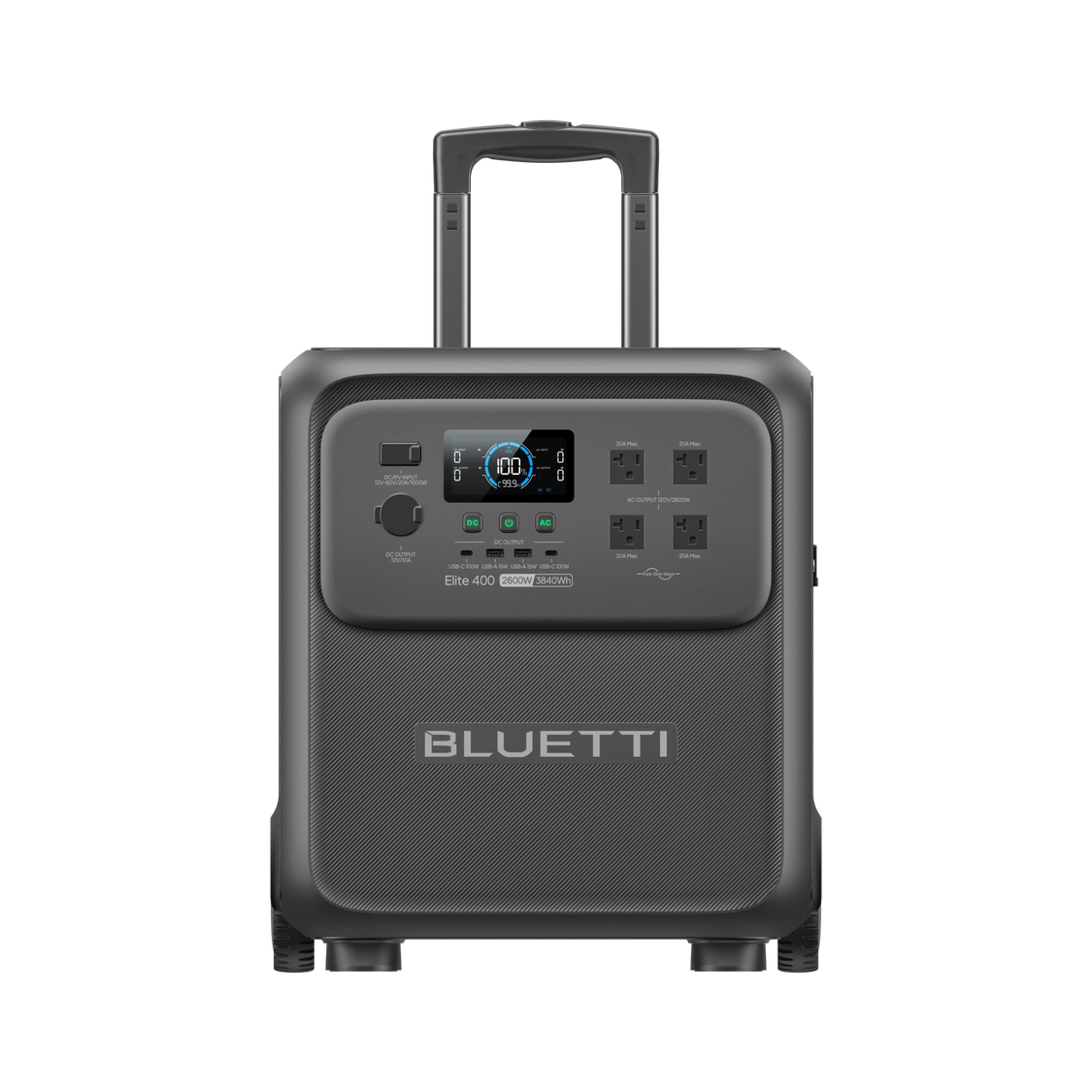
THE SHORT VERSION
A bigger reserve.
A heavier decision.
The Elite 400 makes sense when you want substantial storage in one rolling unit. Its appeal is keeping selected essentials powered while avoiding a separate battery-and-cable setup. Our recommendation depends on your measured energy use, recharge plan, and the route between storage and use.
Wheels help on a clear, level route. They do not solve lifting into a vehicle or carrying up stairs. Check access before choosing capacity: a smaller unit that you can place and recharge easily may serve you better.
Reasons to consider it
- Substantial storage in a single enclosure.
- Built-in wheels and a telescoping handle.
- Several ways to recharge.
- Published backup switching capability.
Tradeoffs to weigh
- Heavy when the route requires lifting.
- Solar equipment increases the total cost.
- Capacity does not remove appliance limits.
- Fastest charging needs two input sources.
Review method: This is a specification-based buying guide. We have not bench-tested the Elite 400 and do not assign an invented review score, noise measurement, or measured runtime.
THE US MODEL
Numbers that matter.
| Stored energy | 3,840Wh |
|---|---|
| Battery chemistry | LiFePO₄ |
| Rated AC output | 2,600W total, 120V |
| Weight | About 86 lb / 39 kg |
| Dimensions | 16.8 × 11.3 × 19.3 inches |
| USB-C | Two ports, up to 100W each |
| USB-A | Two ports, up to 15W each |
| 12V vehicle outlet | Up to 120W |
| AC input | Up to 1,800W (US) |
| Solar / DC input | Up to 1,000W; 12–60V; 20A max. |
| Combined AC + DC input | Up to 2,800W (US) |
| UPS transfer | Manufacturer-rated 15ms |
| Protection | IP20; keep dry |
Sources: BLUETTI US product page and Elite 400 user manual. Manufacturer figures; not our measurements.
POWER & MOVEMENT
Plan the loads.
Plan the route.
Make two lists before buying: what needs power, and where the station needs to go. Add simultaneous appliance demand and check startup requirements separately. A battery-capacity figure cannot tell you whether a particular motor will start.
The US unit supplies 120V. Check the voltage of every essential appliance rather than assuming a large battery can supply a 240V load. Space heating and cooking can consume a large share of an outage reserve; prioritizing lighting, communications, and refrigeration often changes the purchase decision.
Measure doorways, the intended storage space, and any vehicle loading height. Count steps and obstacles along the route. Arrange lifting help appropriate to the weight. Use the station in a dry place with the ventilation clearance specified in its instructions.
Sources: BLUETTI US product page and Elite 400 user manual. Manufacturer figures; not our measurements.
REFILLING THE RESERVE
The 70-minute headline
needs two inputs.
| US charging route | Published limit / timing |
|---|---|
| AC + solar | Up to 2,800W combined; approximately 70 minutes to 80% |
| AC alone | Up to 1,800W; approximately 1.9 hours to 80%, 2.5 hours to full |
| Solar alone | Up to 1,000W; subject to the voltage and current limits |
The first row requires both AC and sufficient solar input. It is not the wall-outlet-only charging time. Temperature, battery state, charging mode, and available input affect the result.
For solar, match the array’s voltage, current, and connections to the manual. A panel’s printed wattage is not a promise of actual charging power. Compare expected daily energy production with your daily usage; a bigger battery buys time but still needs replenishment.
Sources: BLUETTI US product page and Elite 400 user manual. Manufacturer figures; not our measurements.
ILLUSTRATIVE, NOT MEASURED
Estimate your own load.
This planning tool assumes 85% of nominal capacity reaches the load, allowing a simple margin for losses. It is our illustrative assumption, not a measured efficiency or BLUETTI runtime guarantee. It does not separately model idle draw, so very small loads can be overestimated.
| Average steady load | Illustrative runtime |
|---|---|
| 100W | 32.6 hours |
| 300W | 10.9 hours |
| 600W | 5.4 hours |
| 1000W | 3.3 hours |
| 1500W | 2.2 hours |
| 2600W | 1.3 hours |
Measure a refrigerator over a representative day to capture cycling, then use its average energy consumption. For a desk or communications setup, include every connected device. Real results vary with temperature, settings, aging, and the actual load profile.
COMPARE THE COMPLETE SETUP
Choose around your needs.
Consider a smaller station if your essentials use little energy or you must lift the unit frequently. Consider a modular system if your future plan needs additional storage or different voltage support. Compare the complete equipment list and total cost, including panels, chargers, and cables.
BEFORE ORDERING
Compare the complete offer.
Our CJ link opens BLUETTI’s store. Select the Elite 400 and check the exact bundle, included cables, seller terms, and delivery details. We do not freeze a changing sale price into this review.
Browse BLUETTI ↗Affiliate link · Opens the BLUETTI storeQUESTIONS ANSWERED
Elite 400 FAQ.
Will it power an entire home?
Plan selected compatible loads within the output and energy limits. Check appliance voltage and startup demand. Connecting to home wiring requires a suitable installation; do not treat a portable station as a plug-in replacement for the grid.
Does 70 minutes apply to charging from the wall?
No. BLUETTI’s 70-minute claim uses simultaneous AC and solar charging. Its US AC-only figures are approximately 1.9 hours to 80% and 2.5 hours to full.
Are wheels enough for solo transport?
They help with rolling, but the unit still weighs about 86 pounds. Stairs, curbs, and vehicle loading require a separate lifting plan.
Can I use the 3,900W figure for motor startup?
No. The documented Power Lifting mode applies to suitable pure resistive loads while actual output remains 2,600W. Check motor starting requirements separately.
Are panels and accessories included?
That depends on the offer. The official station-only listing includes the unit, AC charging cable, and grounding screw; documents are also shown in the box contents. Confirm any solar cables and charger accessories in your selected bundle.
Is this a hands-on review?
No. This page reviews manufacturer specifications and offers planning guidance. Its runtime tool provides calculations, not test results.
DOCUMENTATION
Sources & review method.
Official US product information and indexed model-specific manual sections were checked on September 17, 2026. The review distinguishes combined charging from AC-only charging, and Power Lifting from normal output. No independent performance measurements are claimed.
- BLUETTI Elite 400 US listing — imagery, charging claims, and package information.
- Elite 400 user manual — regional specifications and operating modes.