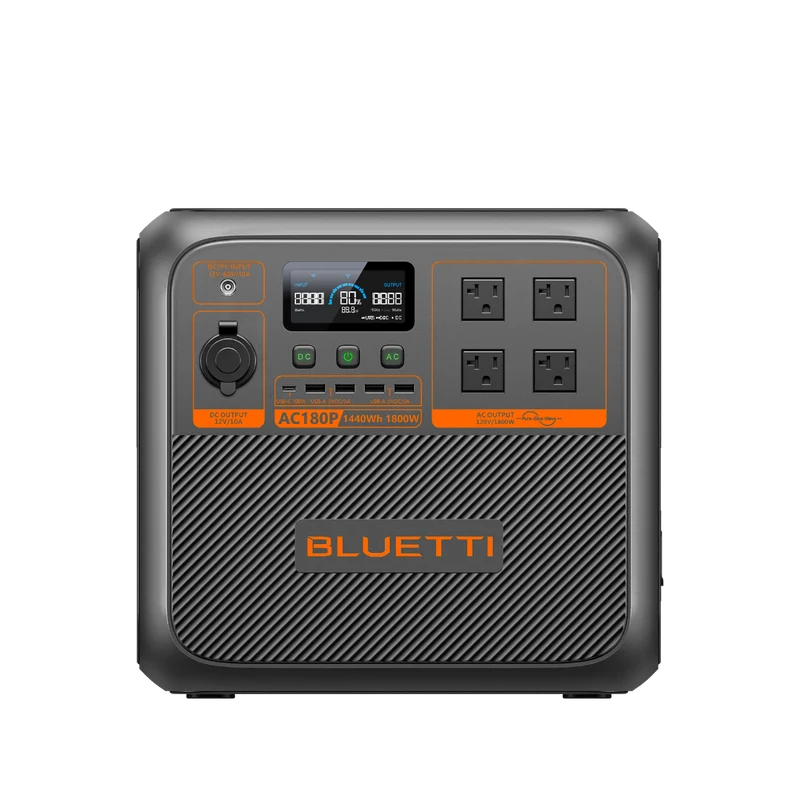
Buy for energy reserve.
Plan around the same inverter.
The AC180P’s extra internal capacity is useful when your appliance already fits the normal output allowance and the limiting factor is how long you can run it. It does not turn the station into a solution for a higher-power load.
For travel or short backup, compare the energy you need between charging opportunities with the complete price. If your daily consumption is still much larger than the reserve, moving up in capacity may be more useful than stretching this platform with external charging accessories.
Review method: This is a specification-based assessment of official documentation. We have not bench-tested this model. Runtime examples are calculations; charging and cycle-life figures are manufacturer claims.
Reasons to consider it
- 25% more nominal energy than the AC180.
- Four US AC outlets and multiple DC options.
- Fast AC charging under suitable conditions.
- Bluetooth monitoring and controls.
- Supported vehicle and external-battery charging options.
Tradeoffs to weigh
- No increase in normal inverter output.
- Hot-weather discharge derating.
- Same solar-input ceiling as the AC180.
- Substantial carrying weight.
- US station-only offer currently out of stock.
The important specifications.
| Item | Specification |
|---|---|
| Battery | 1,440Wh · LiFePO₄ |
| Normal AC output | 1,800W total · Four US 120V outlets |
| Power Lifting | Compatible resistive appliances rated up to 2,700W; reduced operating power |
| Other connections | 100W USB-C · Four USB-A · 12V/10A car outlet · Up to 15W wireless pad |
| AC input | Up to 1,440W; manual specifies maximum at 50–86°F |
| Solar input | 500W maximum · 12–60V · 10A maximum |
| UPS / app | ≤20ms switching specified · Bluetooth |
| Weight / dimensions | About 35.3 lb (16 kg) · 13.39 × 9.72 × 12.48 in |
| Temperature limits | Charging 32–104°F; discharging −4–104°F, with 1,500W maximum specified at 95–104°F |
| Manufacturer claims | 3,500+ cycles · Five-year warranty advertised |
References: US user manual and US listing. Follow the label and current manual for the exact regional unit.
Account for startup demand
and ambient temperature.
The four AC outlets share one output budget. Add simultaneous electrical loads and check startup requirements for motors or compressors. Microwave cooking wattage and an air conditioner’s BTU cooling rating do not establish electrical input demand.
A 1,300W hair dryer is below the normal rating when used alone. It should not be described as requiring Power Lifting simply because it is a heating appliance. A sustained high load still uses the energy reserve quickly.
Power Lifting is for suitable resistive loads operated at reduced power. Its headline figure does not prove compressor or motor startup compatibility. For UPS use, check the connected device and follow the manual’s instruction to turn off Grid Enhancement mode, which can lengthen transfer time.
Choose charging for the complete trip.
BLUETTI advertises 0–80% AC charging in 45 minutes. Treat that as a manufacturer claim under suitable conditions, not a fixed time for every session. Battery state, temperature, supply, connected loads, and selected mode affect charging.
Solar panels must meet the input voltage and current requirements, including open-circuit voltage rising in cold conditions. Select wiring and connectors from the manual. A panel wattage headline alone is not a compatibility check or daily-energy forecast.
The current listing offers a Charger 1 bundle marketed with a 560W alternator charger. It is a separate supported vehicle installation, not the charging speed obtained from an ordinary cigarette-lighter socket. Include charger, wiring, and installation in the price comparison.
Vehicle fast charging is not exclusive to the AC180P: the current AC180 listing also contains vehicle-charger options. Compare the exact supported package instead of assuming the P model alone is the van-use choice.
Check included cables and packing lists for the precise station or bundle. Do not assume solar panels or external-battery cables ship with the base station.
Use average demand
for runtime planning.
These AC scenarios assume 90% depth of discharge, 85% conversion efficiency, and a 15W operating allowance, following the manual’s calculation approach. We apply overhead consistently, including high loads. These are illustrative calculations, not measured results.
| Average AC load | Estimated runtime |
|---|---|
| 20W | 31.5 hours |
| 60W | 14.7 hours |
| 100W | 9.6 hours |
| 120W | 8.2 hours |
| 200W | 5.1 hours |
| 600W | 1.8 hours |
| 800W | 1.4 hours |
| 1,300W | 0.8 hours |
| 1,500W | 0.7 hours |
| 1,800W | 0.6 hours |
Formula: 1,440 × 0.90 × 0.85 ÷ (average AC load watts + 15). Full starting battery, no incoming charge. Actual losses, settings, temperature, and battery condition vary. This is not a USB/DC runtime model.
A cycling fridge can be modeled using measured average consumption; its compressor-starting requirement remains a separate question. There is no universal multiplier to turn a running-wattage example into actual runtime.
At 100W average demand, this example gives about 9.6 hours. That is our calculation using the stated AC180P capacity, not a guaranteed result. For high loads, also account for the temperature derating described above.
External charging
is different from expansion.
The internal nominal capacity remains 1,440Wh. BLUETTI lists supported Power Bank charging from B80, B230, or B300 batteries using the appropriate separately purchased connection.
This transfers energy through a charging input. It is different from directly integrating an expansion pack, and it does not increase the normal inverter ceiling. Adding nominal battery capacities does not tell you how much energy reaches appliances because transfer and conversion losses remain.
AC180P or AC180?
| Specification | AC180P | AC180 |
|---|---|---|
| Nominal battery | 1,440Wh | 1,152Wh |
| Normal AC output | 1,800W | 1,800W |
| US AC outlets | Four | Four |
| Solar input ceiling | 500W | 500W |
| Connectivity | Bluetooth | Bluetooth |
| Published comparison size | 13.4 × 9.7 × 12.5 in | 13.4 × 9.7 × 12.5 in |
| Published comparison weight | 35.3 lb | 35.3 lb |
BLUETTI’s comparison chart shows the same size and weight, with 288Wh more nominal capacity in the P model. The AC180 listing also quotes a different weight in descriptive text, so avoid promising that every exact unit weighs identically. Confirm the unit if lifting is a concern.
Compare complete offers on the day of purchase. Neither model is always cheaper, and cost per nominal Wh is only one part of value. If your loads need more output or a lighter carry, the extra energy does not solve that requirement.
The US Elite 100 V2 also has four AC outlets. Its higher solar-input ceiling, Wi-Fi connectivity, and lower weight are useful comparison points; outlet count is not an AC180P advantage over that US model.
Check the exact offer.
The selected AC180P station-only offer on BLUETTI’s US store showed Out of Stock when checked September 17, 2026. Availability can differ by bundle and seller. Verify the model, condition, warranty, return policy, accessories, and delivery before purchasing.
Our CJ link opens BLUETTI’s store. Check AC180P availability and available alternatives there; the link does not promise stock.
Browse BLUETTI ↗Affiliate link · Opens the BLUETTI storeAC180P FAQ.
Does the extra battery increase output?
No. It increases nominal energy reserve while normal AC output remains 1,800W under applicable conditions.
Does derating begin at 86°F?
The US manual specifies 1,500W maximum discharge at 95–104°F. Its maximum AC-input power has a separate temperature specification.
Will it run an air conditioner?
Check electrical running and startup demand, ambient temperature, and installation. A BTU figure alone cannot establish compatibility. Power Lifting is not a universal compressor-starting allowance.
Does it have remote Wi-Fi control?
The documentation lists Bluetooth, which requires a nearby connection.
Can an external battery increase capacity?
Supported Power Bank arrangements provide external charging energy, with transfer losses and input limits. They do not change the internal nominal capacity or inverter rating.
Is it currently in stock?
The selected US station-only listing showed out of stock when checked September 17, 2026. Recheck the actual seller and bundle before ordering.
Sources and review method.
Documentation and selected US availability checked September 17, 2026. This is an assessment of published specifications, not hands-on testing. Runtime figures are calculated scenarios. Product image supplied by BLUETTI.
- AC180P US listing — comparison, claims, bundles, and official image.
- AC180P US manual — electrical limits, thermal derating, charging, and UPS instructions.
- AC180 US listing and Elite 100 V2 US listing — comparison models.