A portable reserve.
A capable set of connections.
The Elite 100 V2 is worth comparing when you frequently carry a station or recharge it from a substantial compatible solar array. Those benefits can matter more than maximizing nominal watt-hours in a stationary setup.
Its internal reserve is smaller than the AC180’s. Both have the same normal AC output rating, so the newer model is not automatically an upgrade for larger appliances. Compare electrical compatibility, daily energy needs, complete prices, and accessories.
Review method: We assessed official specifications and the US manual. We have not conducted hands-on testing. Runtime scenarios are calculations; charging, noise, and cycle-life figures are manufacturer claims. No measured performance score is assigned.
Reasons to consider it
- Lighter than the AC180.
- Higher solar input ceiling.
- Wi-Fi and Bluetooth control.
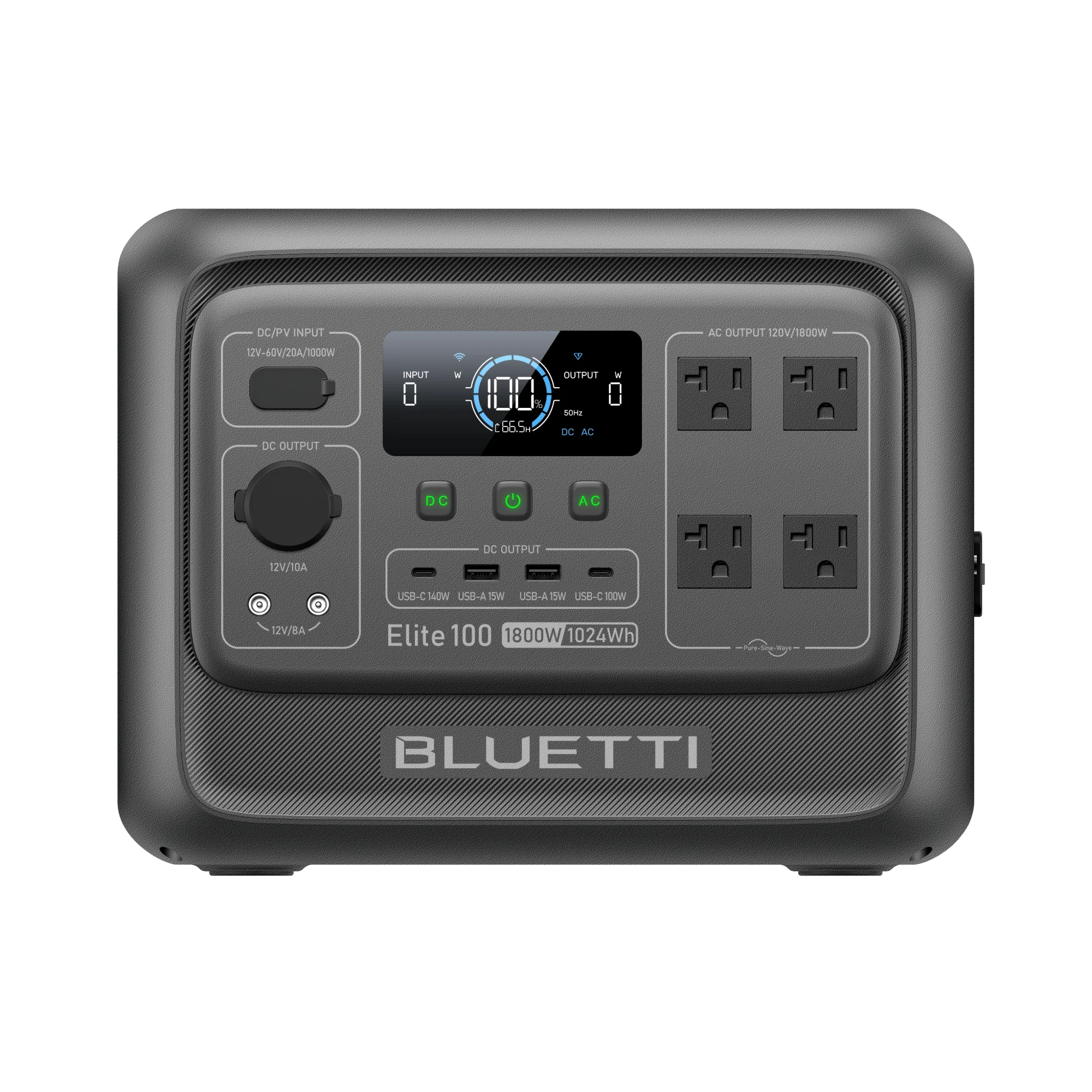
- Four US AC outlets.
- Two USB-C ports with different power ratings.
- Configurable charging and UPS modes.
Tradeoffs to weigh
- Less internal energy than the AC180.
- Sustained high loads drain it quickly.
- Vehicle fast charging needs separate hardware.
- Solar performance depends on the complete array.
- UPS compatibility is device dependent.
- Accessory charging differs from integrated expansion.
The important specifications.
| Battery | 1,024Wh · LiFePO₄ |
|---|---|
| AC output / ports | 1,800W total, 120V · Four outlets on the US model |
| Power Lifting | Compatible pure resistive appliances rated up to 2,700W; reduced operating power |
| USB-C | One 100W port and one 140W port |
| Other DC outputs | Two USB-A · 12V/10A car outlet · Two DC5521 connections |
| Shared 12V limit | Car outlet and DC5521 connections share 10A total; DC5521 pair limited to 8A, 5A per port |
| AC / solar charging | 1,200W AC maximum · 1,000W solar maximum, 12–60V, 20A |
| Combined charging | 1,200W maximum; individual input ratings are not additive |
| UPS / app | ≤10ms transfer specified · Wi-Fi and Bluetooth |
| Weight / dimensions | About 25.3 lb (11.5 kg) · 12.6 × 8.5 × 9.8 in |
| Manufacturer claims | 4,000+ cycles to 80% capacity · Five-year warranty advertised |
Sources: US user manual and current US listing. Regional port layouts differ. Follow the applicable label and manual for your exact model.
Use normal output for appliance planning.
All four AC outlets share the station’s AC allowance. Add simultaneous electrical loads and check startup demand separately for motors and compressors. A microwave’s cooking-wattage headline can be lower than its electrical input.
Direct USB-C charging can avoid a laptop’s AC-adapter path when its device and cable support the required profile. The 12V connections have shared limits, so do not add every port rating into a larger available-power budget.
For backup equipment, the UPS transfer rating is a useful specification rather than a guarantee that every device will avoid a reboot. The manual specifically cautions against Grid Self-Adaption mode for servers or workstations requiring high-performance UPS operation.
Higher solar input.
Real-world limits still apply.
BLUETTI advertises an AC charge to 80% in 45 minutes and a full solar recharge in 70 minutes under suitable conditions. These are manufacturer claims, not fixed times for every session. Battery temperature, charge level, settings, loads, and available input affect the result.
Select solar wiring from voltage, current, connectors, and the manual’s cable instructions. Account for open-circuit voltage rising in cold conditions. Two panels with a convenient combined wattage are not automatically a compatible array.
A higher input ceiling can capture more power when the array supplies it. A smaller or poorly illuminated array may see little benefit. A larger compatible array on a lower-input station is capped at its input limit, but may still improve yield during weaker sunlight.
Fast alternator charging uses a supported separate Charger 1 or Charger 2 setup. A normal cigarette-lighter socket does not provide the advertised fast vehicle-charging performance. Include charger, cables, and installation in the price comparison.
The current page lists an AC cable, solar cable, grounding screw, and manual. Check the exact offer’s packing list and shipment schedule before purchase.
Estimate from average demand.
These AC examples use the manual’s 90% depth-of-discharge assumption, a conservative 90% inverter-efficiency allowance, and approximately 10W operating consumption. They are planning calculations rather than measured results.
| Average AC load | Estimated runtime |
|---|---|
| 20W | 27.6 hours |
| 60W | 11.8 hours |
| 100W | 7.5 hours |
| 120W | 6.4 hours |
| 200W | 3.9 hours |
| 500W | 1.6 hours |
| 800W | 1.0 hours |
| 1,000W | 0.8 hours |
| 1,500W | 0.5 hours |
| 1,800W | 0.5 hours |
Formula: 1,024 × 0.90 × 0.90 ÷ (average AC load watts + 10). Full starting battery, no incoming charge. Actual temperature, losses, settings, and battery condition vary. This is not a USB/DC runtime model.
For refrigeration, measure consumption over a representative period. Compressor cycling does not justify a universal two- or three-times-runtime multiplier. For a whole outage, total every device’s daily energy use instead of assuming a standard household-essentials figure.
For a CPAP or other medical device, determine requirements with the device manufacturer and a qualified clinician. Heated accessories, settings, and connection method affect consumption. This review does not establish medical suitability or guarantee uninterrupted overnight operation.
Accessory charging is a separate system.
The station has a fixed internal nominal capacity. The current listing also offers an Elite 100 V2 + Charger 2 + B300K + DC Hub bundle, so a blanket claim that there are no external-battery options is incomplete.
An accessory charging arrangement is different from adding an integrated expansion pack to the station. Confirm the supported battery, hub, charger, cable, operating modes, and complete connection diagram before purchasing. Transfer losses and input limits affect useful energy.
Elite 100 V2 or AC180?
| Specification | Elite 100 V2 | AC180 |
|---|---|---|
| Nominal energy | 1,024Wh | 1,152Wh |
| Normal AC output | 1,800W | 1,800W |
| US AC outlets | Four | Four |
| Solar input ceiling | 1,000W | 500W |
| App | Wi-Fi + Bluetooth | Bluetooth |
| UPS specification | ≤10ms | 20ms advertised in BLUETTI’s comparison |
Choose according to carrying weight, solar setup, connectivity, and required runtime. The AC180 holds 128Wh more nominal energy; the Elite 100 V2 provides a higher solar-input ceiling and lower weight. Neither advantage guarantees better value at every sale price.
Noise claims should be compared under matching test conditions. BLUETTI advertises 30dB under light load for this model, while its manual lists 50dB maximum. We have not measured either figure, and do not compare light-load operation with another station’s charging noise.
Compare the complete offer.
Verify the US Elite 100 V2, included cables, warranty and return terms, delivery dates, and accessories. Compare station-only, solar, and vehicle-charging bundles by the equipment you need rather than promotional pictures.
Our CJ shopping link opens BLUETTI’s store. Select the Elite 100 V2 there and verify the current offer.
Browse BLUETTI ↗Affiliate link · Opens the BLUETTI storeElite 100 V2 FAQ.
Does the US model only have two AC outlets?
No. The US model shown by BLUETTI has four AC outlets. Regional configurations differ.
Can it recharge fully from solar in 70 minutes?
BLUETTI advertises that time under suitable conditions. Actual input depends on the array, weather, temperature, battery state, and settings.
Does the AC180 have UPS switching?
Yes. BLUETTI’s current Elite 100 V2 comparison lists 20ms for the AC180. The older claim that it does not advertise UPS is incorrect.
Can I monitor it remotely?
Wi-Fi and Bluetooth are supported. Remote access depends on the configured app, account, network, and available connection.
Does it guarantee a decade of battery life?
No cycle-life figure guarantees calendar life. Use, temperature, storage, and battery aging affect service life.
Does 10ms UPS guarantee every device stays on?
No. Check the specific equipment and operating mode. The manual restricts Grid Self-Adaption mode for devices needing high-performance UPS operation.
Sources and review method.
Official documentation checked September 17, 2026. This is a specification-based review. Runtime examples are calculations and no hands-on testing is claimed. Follow the current regional manual and firmware instructions.
- Elite 100 V2 US listing — claims, comparison, accessories, and official image.
- Elite 100 V2 US manual — input and output limits, runtime assumptions, UPS, and shared DC connections.
- AC180 US listing — comparison model.